How to Choose the Right LED Headlamp for Night Fishing, Running, and Patrol
Whether you are casting a line at midnight, logging miles before sunrise, or walking a security route through a dark facility, one piece of gear determines how safe and effective that time in the dark will be: your headlamp. Not every LED headlamp is built for every job, and buyers who treat “bright” as the only spec often end up with a light that blinds their own night vision on the water, dies halfway through a patrol shift, or fogs up the first time it rains. This guide breaks down the technical factors that actually matter — output, beam type, water resistance, runtime, weight, and lighting modes — and maps them to the real demands of night fishing, night running, and security patrol.
Across all three use cases, the underlying question is the same: what does this light need to do, for how long, and under what conditions? An angler standing at the edge of a dark riverbank has different priorities than a runner covering six miles before dawn, and both differ again from a security officer walking a facility for an eight-hour shift. Understanding the specs behind the marketing — and how those specs translate into real performance — makes it far easier to choose a headlamp that will actually hold up to the job rather than one that simply looks impressive on a product page.
Why “Lumens” Alone Won’t Tell You Enough
Most headlamp listings lead with a lumen number, and it is tempting to assume higher is simply better. In practice, lumens measure total light output, not how far or how precisely that light reaches. A wide-angle floodlight and a tight-focus spotlight can carry the same lumen rating and perform completely differently in the field. Distance throw is actually governed by candela (beam intensity), while lumens describe overall brightness.
Reputable manufacturers test their headlamps against the ANSI/NEMA FL1 standard, an independent benchmark that regulates how lumens, beam distance, runtime, and impact resistance are measured and reported, so the numbers on the packaging can be compared apples-to-apples across brands (Pelican’s guide to ANSI flashlight standards). When comparing headlamps, look for FL1-tested specs rather than marketing claims alone, and remember that a well-focused 500-lumen beam can out-throw an unfocused 1,000-lumen one.
What to look for by activity:
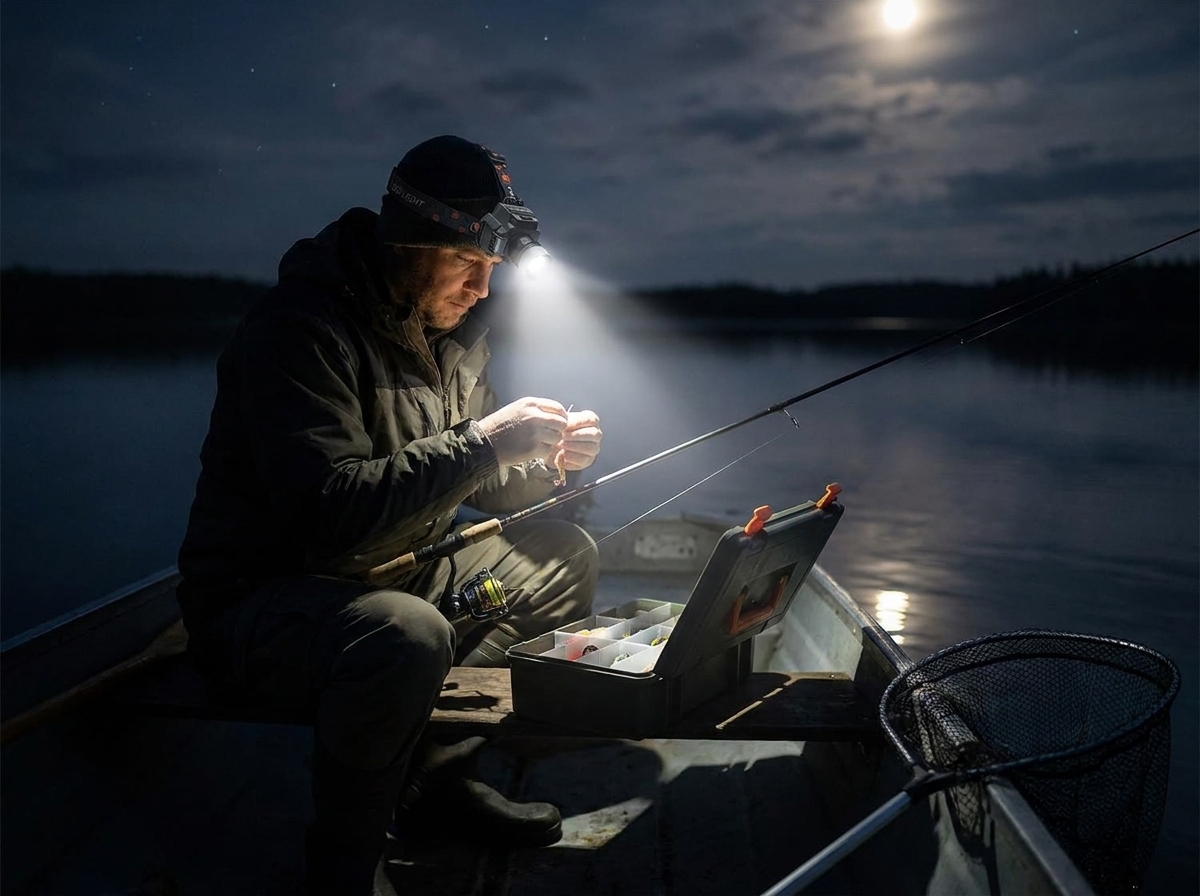
- Night fishing: 200–500 lumens is typically enough for close-range tasks like tying knots, netting a fish, and reading a rod tip; a longer-throw spot mode helps when scanning open water or a riverbank.
- Night running: 200–400 lumens with a wide flood beam is usually sufficient to light the path immediately ahead and reveal uneven terrain without overexposing your immediate field of view.
- Patrol duty: 300–800+ lumens with a strong spot beam and adjustable output lets an officer or guard illuminate a stairwell, a parking structure, or a distant blind spot on demand.
Beam Type: Spot, Flood, or Dual-Mode
The shape of the beam matters as much as its strength.
- Flood beams spread light evenly across a wide area, which is ideal for close-up work — tying fishing knots, reading trail markers, or checking a badge at a checkpoint.
- Spot beams concentrate light into a narrow, far-reaching column, useful for scanning a treeline, spotting a runner’s obstacle 50 meters out, or identifying a subject at a distance during patrol.
Dual-mode or zoomable headlamps let the same unit switch between the two, or telescope the lens to adjust throw distance. For users who move between tasks — say, tying tackle, then walking to a new fishing spot — a zoomable, multi-level headlamp offers more flexibility than a single fixed-beam light. LEBOTE’s sensor headlamp line is built around this kind of adjustable, multi-level output so one headlamp can cover close work and long-distance visibility without switching devices.
Waterproof and Impact Ratings: Non-Negotiable for Outdoor Use
Night fishing means humidity, splashes, and occasional full submersion risk near the water’s edge. Night running means sudden rain and sweat exposure. Patrol work means all-weather reliability, often in the same shift. This makes an IP (Ingress Protection) rating one of the most important — and most overlooked — specifications on a headlamp.
|
IP Rating |
Protection Level |
Best Suited For |
|
IPX4 |
Splash-resistant from any direction |
Light rain, sweat, casual outdoor use |
|
IPX6 |
Resistant to powerful water jets |
Heavy rain, boat spray, riverbank fishing |
|
IPX7 |
Withstands temporary submersion (up to 1m) |
Accidental drops in water, wading, wet-weather patrol |
|
IPX8 |
Rated for continuous submersion beyond 1m |
Extreme wet-weather or water-adjacent professional use |
For night fishing in particular, an IPX6 or higher rating is worth prioritizing, since gear near open water is far more likely to get soaked than dropped. Running and patrol headlamps can generally perform well at IPX4–IPX6, provided the housing is also rated for basic impact resistance.
Battery Life, Charging, and Power Reserves
A headlamp that dies at hour three of a five-hour patrol or a long night session on the water isn’t just an inconvenience — it is a safety issue. When comparing runtime claims:
- Check the runtime at the brightness level you’ll actually use, not just the lowest “eco” mode, since manufacturers often advertise their longest runtime figure at minimal output.
- USB Type-C rechargeable headlamps have become the practical standard for outdoor and professional use, since they can be topped up from a power bank, vehicle charger, or laptop mid-shift.
Some multi-functional headlamps, including several models in LEBOTE’s full headlamp and flashlight catalog, double as power banks or offer a battery-level display, which is particularly useful for patrol teams that need to track remaining charge across a full shift.
- Runners and anglers on multi-hour outings should look for a stated runtime of at least 6–8 hours on a mid-brightness setting, plus a spare battery or power bank as backup.
Weight, Fit, and Comfort
A headlamp that feels fine for ten minutes can become uncomfortable after two or three hours — and discomfort leads people to loosen straps, remove the light, or simply stop wearing it correctly, defeating the point.
- Night running demands the lightest possible unit with a snug, non-bouncing headband, since any shift in weight becomes noticeable with every stride.
- Night fishing sessions are often stationary or slow-moving, so slightly heavier, more feature-rich headlamps are more tolerable, though a padded, adjustable band still matters for multi-hour trips.
- Patrol shifts can run eight-plus hours, making an adjustable, breathable headband and a low center of gravity essential to avoid fatigue and pressure headaches over a full duty period.
Lighting Modes That Matter in the Field
Beyond raw brightness, the mode selection built into a headlamp often determines how usable it is for a specific task:- Red light mode preserves night vision and avoids spooking fish — a near-essential feature for serious night anglers, and useful for patrol personnel who need to move without announcing their position with white light.
Strobe/SOS mode is a practical safety feature for both runners (to increase visibility to drivers, echoing the guidance in REI’s night-running safety advice that headlamps and flashing lights are essential for being seen) and anglers or patrol staff signaling for help.
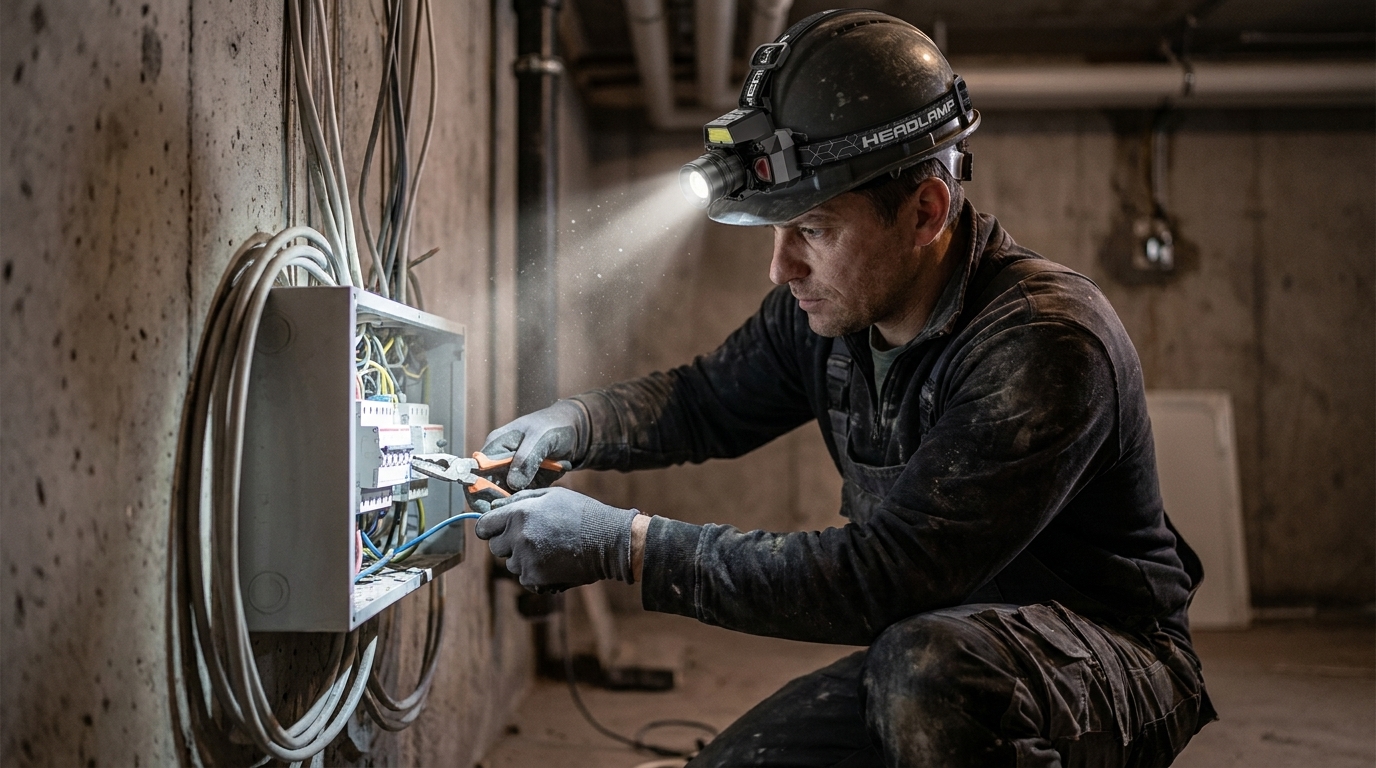
Motion or induction sensors, now common on hands-busy headlamps, let users switch brightness levels with a wave of the hand — useful when hands are wet, gloved, or occupied with a rod, radio, or flashlight in the other hand. LEBOTE’s induction-sensor headlamp range, detailed on the flashlight and headlamp manufacturer page, is built specifically around this kind of hands-free operation for night patrol, emergency repair, and outdoor work.
Matching the Headlamp to the Job: A Quick Comparison
|
Requirement |
Night Fishing |
Night Running |
Security Patrol |
|
Brightness |
200–500 lm, spot/flood combo |
200–400 lm, wide flood |
300–800+ lm, adjustable spot |
|
Waterproof rating |
IPX6–IPX7 |
IPX4–IPX6 |
IPX4–IPX6 |
|
Weight priority |
Moderate |
Highest |
Moderate-high |
|
Key mode |
Red light |
Strobe/flash |
Red + white + strobe |
|
Runtime |
6–10+ hrs |
3–6 hrs |
8+ hrs, rechargeable mid-shift |
|
Extra feature |
Hands-free knot-tying light |
Reflective/blinking rear element |
Battery display, durable housing |
Common Mistakes to Avoid When Buying
Even experienced outdoor and professional users make a few recurring mistakes when shopping for a headlamp:
- Chasing the highest lumen number without checking runtime at that brightness. A headlamp advertised at 1,000+ lumens may only sustain that output for a minute or two before stepping down significantly — always check the runtime curve, not just the peak figure.
- Ignoring the waterproof rating until it’s too late. A headlamp that is only splash-resistant (IPX4) will not hold up to a sudden downpour on a patrol route or a slip near the water’s edge while fishing.
- Overlooking weight and headband quality. A heavy or poorly padded headlamp becomes a distraction — and eventually gets removed — well before the battery runs out.
- Choosing a single fixed beam when the job actually requires both close-up and long-distance lighting. Anglers switching between tying knots and scanning the water, or patrol staff moving between hallways and open lots, benefit far more from an adjustable or dual-mode headlamp than a single-purpose one.
- Buying on brightness claims alone without checking certification. Headlamps tested against ANSI/NEMA FL1 or similar standards, with visible IP ratings and safety certifications such as CE and RoHS, are far more likely to perform as advertised than uncertified budget alternatives.
-
A Note on Safety Beyond the Light Itself
A good headlamp is one part of a broader safety setup. Night anglers should always fish with a buddy where possible and carry a backup light source in case the primary unit fails or gets wet. Night runners should pair a headlamp with reflective clothing and stick to familiar, well-populated routes, since visibility to others matters as much as your own visibility of the path. Patrol personnel should treat their headlamp as backup lighting to standard-issue equipment and radios rather than a sole point of failure. In every case, choosing a headlamp with the right combination of brightness, waterproofing, runtime, and hands-free control meaningfully reduces the risk that comes with working or playing after dark.
Frequently Asked Questions
How many lumens do I actually need for night fishing?
For most bank or boat anglers, 200–500 lumens on a mid setting is enough to tie knots, land fish, and move around a dock or kayak safely. Very high lumen counts are rarely necessary at close range and can actually wash out your near vision or spook fish if used in white light mode near the water.
Is IPX6 waterproofing enough, or do I need IPX7/IPX8?
IPX6 is generally sufficient for rain, spray, and splashes from a boat or riverbank. If there is a realistic chance the headlamp could be fully submerged — for example, wading, kayak fishing, or a slip near deep water — an IPX7 or IPX8 rating provides meaningfully more protection and peace of mind.
Why does red light mode matter if I'm only running, not fishing?
Red light preserves night vision, which is most valuable for anglers watching a rod tip or patrol staff observing a dim area. For running, it is less essential, though some runners still use a dim red mode at trailheads or rest stops to avoid disturbing other people's night vision without shutting the light off completely.
What's the practical difference between lumens and candela?
Lumens describe the total amount of light a headlamp emits in every direction, while candela measures the intensity of the beam at its brightest point — essentially how far it throws. Two headlamps with identical lumen ratings can have very different beam distances depending on how tightly the light is focused, which is why beam distance (often listed in meters) is a more useful spec than lumens alone when long-range visibility matters, such as scanning a parking lot during patrol.
Are motion-sensor headlamps reliable in wet, cold, or gloved conditions?
Quality induction-sensor headlamps are designed to work through light rain, gloves, and cold weather, since the sensor typically responds to a hand pass rather than requiring bare-skin contact. It is still worth checking the IP rating of the specific model, since sensor components can be more sensitive to heavy water exposure than a simple physical button.
How often should I replace or recharge a headlamp battery for daily professional use?
For patrol or other daily-use scenarios, recharge the headlamp after every shift rather than waiting for it to run flat, since lithium batteries generally last longer with regular partial charging than with deep discharge cycles. Most rechargeable headlamp batteries maintain strong capacity for 300–500 charge cycles, roughly one to two years of daily professional use, before a noticeable drop in runtime.
Light Up Every Shift, Run, and Cast with LEBOTE
As a specialist mobile lighting manufacturer since 2010, LEBOTE designs rechargeable LED headlamps built for exactly these conditions — induction-sensor models for hands-free patrol and repair work, multi-level zoom headlamps for anglers who need both flood and spot output, and lightweight sensor headlamps suited to long runs or shifts. Every model is tested to CE, RoHS, and FCC standards, with waterproof and impact testing built into our production process. Browse our full range of LED headlamps and flashlights, or contact our team for OEM/ODM options tailored to your brand and application.
2026 Top 10 Mobile Lighting Manufacturers in China: A B2B Sourcing Guide
Best Rechargeable Work Lights for Auto Repair Shops