Work Lights for Warehouse and Night-Shift Logistics Teams
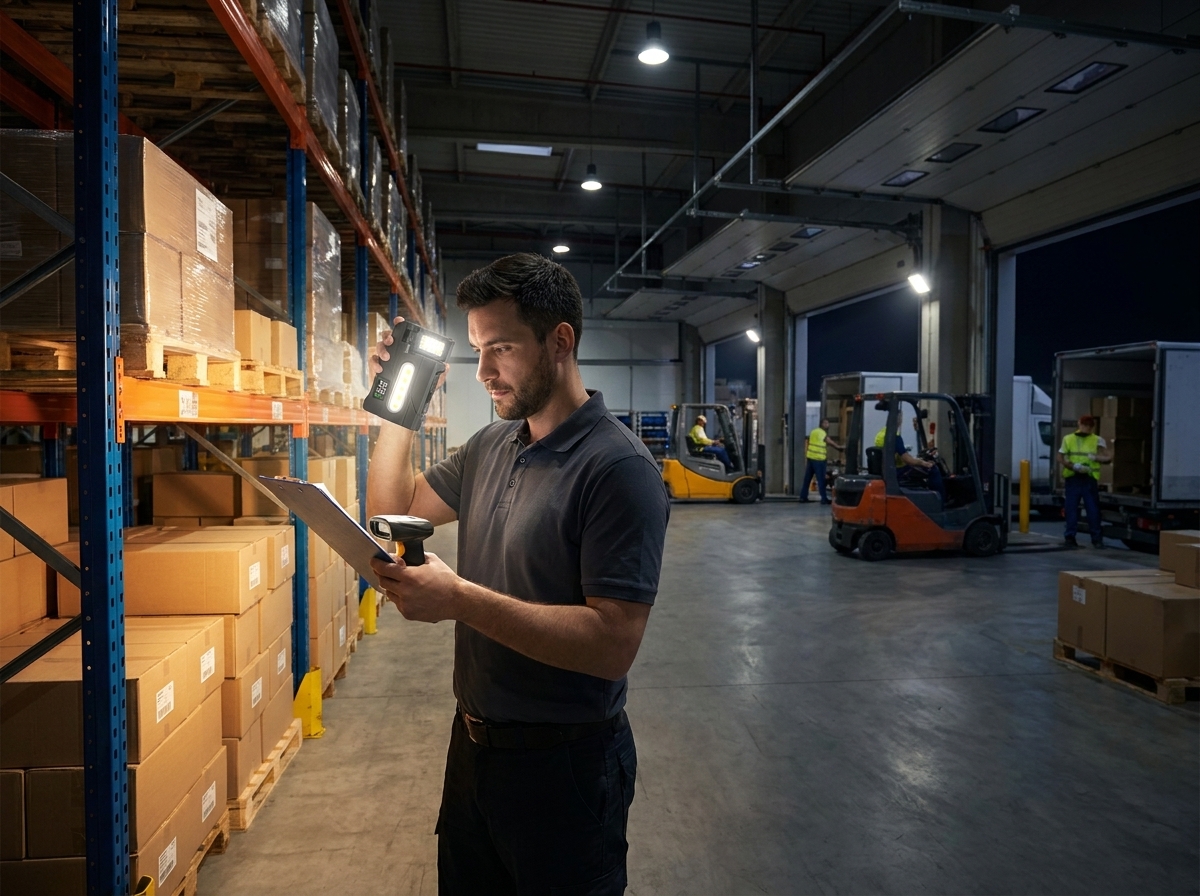
Warehouses don't really sleep anymore. Between overnight replenishment, cross-docking, cold-chain fulfillment, and the relentless pace of e-commerce order cycles, a large chunk of logistics work now happens after dark. Overhead fixtures handle the main aisles fine, but they rarely reach into a trailer bed, a blind racking corner, a jammed conveyor housing, or the back of a forklift engine bay at two in the morning. That's the gap portable work lights fill — and it's also where a bad purchasing decision quietly costs a facility money, safety incidents, and staff turnover.
Below, we'll walk through why lighting has moved up the procurement priority list for warehouse and 3PL operators, which specs are actually worth paying attention to, and how different roles on the floor need different tools.
Why Lighting Has Become a Supply Chain Priority
Night and rotating shifts already come with a fatigue problem built in. NIOSH's research on shift work points to significantly higher rates of disrupted sleep and daytime drowsiness among night- and evening-shift employees compared with day workers, and that fatigue shows up as slower reaction time and reduced attention — a safety issue on its own. Add poor task lighting on top of that, and workers end up squinting at labels, misjudging distances, or reaching blind into spaces near moving equipment.
A few places where this tends to surface on the floor:
- Picking and scanning errors go up when barcodes, SKU numbers, or damage marks aren't clearly visible.
- Near-misses cluster around loading docks, mezzanines, and racking wherever footing or surroundings are hard to see.
- Repairs take longer when a technician can't get a clear look inside a machine housing or engine bay.
- Retention suffers — nobody wants to work a shift where the basics, lighting included, feel like an afterthought.
None of this means rewiring the whole building. Usually it just means putting the right portable light in the right worker's hands.
What Regulators Actually Expect
Lighting isn't only a comfort question — it's tied to compliance too. In the U.S., there are real illumination floors for logistics environments. J.J. Keller's breakdown of OSHA's lighting rules notes that the powered industrial truck standard calls for auxiliary directional lighting once general area lighting drops below about two lumens per square foot, and general industry guidance runs from roughly half a foot-candle in low-hazard office spaces up to five foot-candles in higher-hazard areas like machine shops and engine rooms. Loading docks, staging lanes, and deep racking aisles fall below those numbers more often than facility managers expect — fixtures age, get blocked by tall inventory, or simply don't reach the far corners of a facility that's grown since the lights went in.
That's where portable, rechargeable lighting earns its place. It's a far cheaper fix than a rewiring project, and it puts light exactly where a task needs it.
Specs Worth Checking Before You Buy
A high lumen number on a spec sheet doesn't always translate to good performance on the floor. Here's what's actually worth checking:
Verified brightness and runtime. Lumen and runtime claims only mean something if they're tested consistently. The ANSI/NEMA FL1 standard sets a common method for testing light output, beam distance, runtime, impact resistance, and water resistance, so a "1,000-lumen" claim from one factory can actually be compared against another's. If a supplier tests to FL1 and shares the data, that's worth something.
Runtime that fits the shift. An 8-to-12-hour overnight shift needs a light that either lasts the whole thing or recharges fast during a break. A few things to look for:
- Multiple brightness modes, so output — and battery life — can be dialed down when full power isn't needed
- Removable or swappable battery packs for teams running back-to-back shifts
- A low-battery warning, so nobody's left in the dark mid-task
Real durability. These lights get dropped, knocked against racking, and exposed to dust or the occasional splash near a dock door. IP ratings, impact-resistant housings, and drop-test numbers matter a lot more here than they do for a flashlight sitting in someone's kitchen drawer.
Hands-free options. Picking, scanning, packing, repair work — most of it needs both hands. Headlamps, magnetic mounts, and clip-ons solve that in different ways depending on the task.
Color temperature and beam type. Cooler, whiter light around 5000–6500K makes labels and damage easier to read. A mix of flood and spot beams also helps — wide light for scanning a whole area, a tighter beam for something small like a connector or a serial number.
Certifications. For anyone sourcing across borders, CE, RoHS, and FCC marks — plus documented waterproof and impact testing — cut down on compliance headaches at customs.
Matching the Light to the Role
Different jobs on the floor call for different formats. Equip everyone the same way and you'll end up with some teams over-equipped and others still fumbling with a phone flashlight.
- Order pickers and packers do better with a rechargeable headlamp — hands stay free for scanning and box work, and the light follows wherever they're looking.
- Dock and yard crews need something brighter and weather-resistant, with a wide flood beam for trailer interiors and staging lanes.
- Maintenance techs want a magnetic-base or clip-mounted light so both hands are free for tools while working inside a conveyor housing or a forklift compartment.
- Cycle-count and audit teams are better served by something compact with long runtime — they're walking racking aisles for hours and can't be stopping to recharge.
LEBOTE's work light lineup and headlamp range are worth a look here — both are built around rechargeable batteries, multiple brightness settings, and housings rated for industrial use rather than weekend camping trips.
Vetting a Manufacturing Partner
For distributors, safety equipment resellers, and multi-site logistics operators, the supplier relationship matters just as much as any single spec. Before signing off on a partner, it's worth asking:
- Can the factory handle recurring bulk orders without quality slipping between runs?
- Are CE, RoHS, FCC, waterproof, and impact-test results actually documented and available?
- Is there room for customization — branding, packaging, battery capacity, beam angle — for private-label or fleet-standardization programs?
- Does the manufacturer have real experience shipping internationally and handling customs paperwork without delays?
LEBOTE, operated by Ningbo Lecho Electronics, has been manufacturing and exporting mobile lighting for over a decade, with CE, RoHS, FCC, waterproof, and impact-test certification behind its products — details are on the company's about page. That mix of tested products and export experience is exactly what's worth checking before committing to a bulk order.
Don't Just Look at Unit Price
It's tempting to default to whichever quote has the lowest per-unit cost, but lighting is one of those categories where that number can be misleading. A light built around a cheap battery cell or an unrated housing has a way of coming back around — as a warranty claim, an early reorder, or worse, an incident report. Worth factoring in:
- How often it needs replacing. Weak batteries and seals wear out faster under daily drop-and-recharge cycles, so the real lifetime cost per unit can end up higher than the sticker price suggested.
- Time lost during repairs. A technician working without decent hands-free light takes longer on jobs like conveyor repair or forklift servicing — and that adds up across a whole fleet.
- Simpler training. Standardizing on one or two formats, instead of whatever workers happen to bring from home, makes onboarding easier and keeps every shift consistently equipped.
- After-sales support. A supplier that stands behind FL1-tested specs and responds when something breaks saves a lot of administrative back-and-forth down the line.
Looked at this way, the real question isn't "which light is cheapest" but "which light costs the least per hour of actual use over its lifespan" — and that usually points toward the better-built, properly certified option.
Final Thoughts
Portable work lights aren't a throwaway line item on a procurement list. They have a direct effect on safety numbers, picking accuracy, and how much a night shift actually gets done. Getting the spec right — real brightness numbers, runtime that matches the shift, durability that holds up, and the right hands-free format for each role — tends to pay for itself pretty quickly once it's rolled out across a team.
FAQ
How many lumens does a warehouse work light actually need? It depends on the task more than any fixed number. For general area work near a dock or staging lane, 500–1,000 lumens on a portable light is usually enough to supplement fixed fixtures. For deep inspection work — checking damage, reading small print, or working inside equipment — a tighter beam in the 1,000+ lumen range with adjustable modes gives more control than just cranking up brightness.
What's the difference between a headlamp and a handheld work light for warehouse use? Headlamps are built for tasks that need both hands free — picking, scanning, packing, most repair work. Handheld or mountable work lights make more sense when you need to light up a wider area, like a trailer interior or a staging zone, rather than follow exactly where someone's looking.
Do portable work lights need to be waterproof? For indoor-only use in a climate-controlled warehouse, probably not critical. But for loading docks, yards, or cold storage, an IP-rated light (IP54 or higher) holds up much better against dust, condensation, and the occasional splash than a standard consumer-grade light.
How long should the battery last on a night-shift work light? Ideally long enough to cover a full shift — 8 to 12 hours — without a mid-shift recharge. Lights with multiple brightness modes or swappable battery packs give more flexibility here than a single fixed-output battery.
Can LEBOTE customize work lights for a private-label or bulk order? Yes. LEBOTE supports OEM customization — branding, packaging, battery capacity, and beam configuration — along with bulk production and full test documentation for buyers sourcing at scale.
Light Up Your Night Shift With Equipment Built for the Job
Outfitting a warehouse team shouldn't mean guessing at spec sheets. LEBOTE builds rechargeable headlamps and portable work lights for industrial use, with tested brightness, long-runtime batteries, impact-resistant housings, and CE/RoHS/FCC certification built in. Whether you're standardizing lighting across a distribution network or building out a private-label line for your own catalog, our team handles OEM customization, bulk production, and full test documentation. Take a look at the work light collection, or reach out and we can talk through your project specs and order volume.
Best Headlamps for Hunters Balancing Brightness and Stealth
2026 Top 10 Mobile Lighting Manufacturers in China: A B2B Sourcing Guide